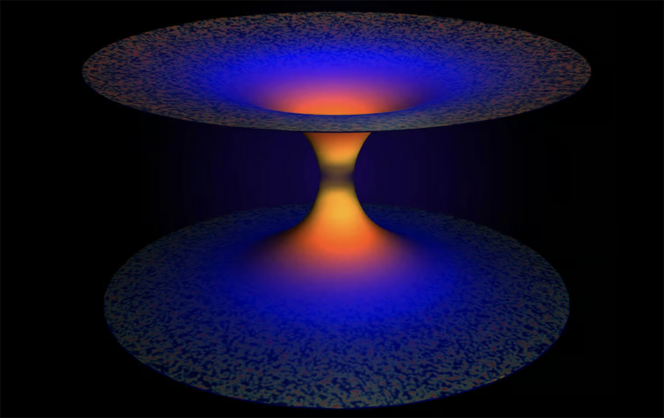
© Alejandro Corichi and J. P. Ruiz
This is a research project funded by the Leverhulme Trust, hosted in the Department of Philosophy at the University of Bristol, and led by Karim Thébault (PI) and Juliusz Doboszewski (Senior Project Advisor). It will run from 1st July 2026 until 31st June 2030.
We are advertising for a post-doctoral researcher to join the project team. You can find out more and apply here.
Project Summary
An important goal of philosophy of science is to aid scientists in formulating precise and useful concepts. This project will create a novel framework, called ‘model-based explication’, that will lead to the refinement of a key scientific concept, ‘singularity resolution’, in the study of black holes and early universe cosmology. In imprecise terms, singularity resolution is the removal of mathematically and physically pathological behaviour within a physical theory. In conducting a model-based explication of singularity resolution we will use simple quantum models of black holes and cosmology to establish a more precise and useful scientific concept applicable in de-idealised contexts.
Project Objectives
The project’s core objective is to provide a model-based explication of singularity resolution in modern theoretical physics. We will pursue this aim through three further sub-objectives:
- Explicate the concept of black hole singularity resolution in terms of necessary and sufficient criteria and relate these criteria to the cosmological case that was studied in previous work
- Use semi-classical analysis to connect quantum singularity resolution to the study of classical singularities in cosmology and black holes within the theorems of Penrose, Hawking and others.
- Articulate the connections between singularity resolution and heuristic principles relating to the arrow of time and chaotic cosmology.
Advisory Board
James Ladyman (University of Bristol)
Dennis Lehmkuhl (University of Bonn)
Daniele Oriti (Universidad Complutense de Madrid)
Christopher Smeenk (Western University)
Dean Rickles (University of Sydney)
Carlo Rovelli (Centre de Physique Theorique de Luminy)
Francesca Vidotto (Instituto de Estructura de la Materia, Madrid)
 Philosophy of Physics Bristol